Twenty years ago, a story began in Druskininkai that is coming full circle this year: Europe’s elite orienteers are returning to the very same forests of the Dzūkija region. In 2006, many of today’s biggest stars took their first steps on the international stage here. Now, Lithuania is preparing to host the largest orienteering event in its history.
From 22nd to 27th September, Druskininkai and the Lazdijai district will host the European Orienteering Championships alongside the final round of the Orienteering World Cup. But this championship carries a special symbolic meaning. Exactly twenty years ago, these same forests became an international orienteering hub when they hosted the World Junior Orienteering Championships (JWOC).
A place where generations of orienteers have grown
The 2006 World Junior Orienteering Championships in Druskininkai became much more than just another international event for Lithuanian orienteering. For many athletes, it was their first experience of top-level international competition. For Lithuania, which had already successfully organised several major international events, it was another important milestone and an opportunity to prove that it had both the expertise and the capability to host world-class competitions.
“Lithuania had already earned an excellent reputation through the 1996 Orienteering World Cup in the Curonian Spit and the 2001 World Masters Orienteering Championships, which attracted nearly 3,000 competitors from around 44 countries. We brought all of that experience into the 2006 World Junior Championships. We chose Druskininkai to showcase the diversity of Lithuanian terrain: the long-distance race took place in the Noškūnai Forest, the middle distance in Petroškai Forest, while the relay was held in Druskininkai Forest with the event centre between Lakes Druskonis and Vijūnėlė.
Then we received a letter from the IOF President asking whether Lithuania would be willing to include sprint races in the championship programme. We simply couldn’t miss the opportunity to become the first organisers of a World Junior Championships featuring this new format. Naturally, it brought additional organisational challenges, but it was also a tremendous vote of confidence in Lithuania,” recalls Rimantas Mikaitis, organiser of the 2006 championships.
According to Mikaitis, during the World Championships held later that year in Denmark, International Orienteering Federation officials were already asking Lithuania when it would be ready to organise a World Orienteering Championships.
“That showed they trusted us and valued our experience and capabilities. At the time, though, I never imagined it would take so long to answer that question—that we would have to wait until a new generation of Lithuanian orienteers had grown up, taken on leadership roles, and set out to organise an event of this calibre themselves.”
Among that new generation is Vilius Aleliūnas, the current Event Director of the European Championships, who himself competed in the 2006 World Junior Championships in Druskininkai.
Returning to the same forests – but they are no longer the same
Twenty years later, athletes will once again race through Petroškai Forest. Yet while the terrain may appear familiar at first glance, in orienteering almost everything changes over two decades.
Egidijus Kukenys, the chief mapper for the European Championships, explains that creating the map for the 16-square-kilometre Petroškai–Klepočiai forest area required around 750 hours of fieldwork—and the work is still not finished.
“Forests constantly change because of natural processes and human activity, so before the championships we’ll spend another couple of weeks checking and updating the finished map,” says Kukenys.
Although Lithuanian forests lack the rocky terrain and boulder fields typical of Scandinavia, they present a completely different set of challenges for orienteers.
According to Kukenys, the greatest challenge is accurately mapping runnability, particularly in areas where spruce forests have been damaged by spruce bark beetle infestations. Yet it is precisely the terrain that makes Petroškai Forest one of Lithuania’s finest orienteering areas.
“This is one of Lithuania’s true gems for orienteering. The forest is full of depressions, hills, slopes of varying steepness cut by gullies, and beautiful natural hornbeam stands. It’s endlessly fascinating to map a place where every hill hides a new surprise.”
From junior starts to the European Championships
Rimantas Mikaitis has no doubt that the 2006 championships left a lasting legacy for Lithuanian orienteering.
“I’ve heard this year’s Event Director, Vilius Aleliūnas, say that without the 2006 World Junior Championships in Druskininkai, there would be no 2026 European Championships. It’s wonderful to see that the original vision has remained intact: Druskininkai, Noškūnai Forest, Petroškai Forest… All of it brings back memories.”
Vilius Aleliūnas agrees:
“In 2006, Lithuania showed it could organise an unforgettable World Junior Orienteering Championships. In 2026, we want to show even more. We want every athlete who comes to Lithuania to leave with more than memories of technically demanding courses and the beautiful forests of Dzūkija. We want them to remember a country that truly loves orienteering. If, twenty years from now, someone looks back on these championships the way we remember 2006 today, we’ll know we’ve done our job well.”
From 22 to 27 September, Druskininkai and the Lazdijai district will host the European Orienteering Championships and the final round of the Orienteering World Cup. The week-long event will be one of Lithuania’s largest international sporting events of the year, bringing together Europe’s strongest orienteers, hundreds of team members, and thousands of orienteering enthusiasts from across the continent.
The European Orienteering Championships 2026 now has its own sound: we present the official championship song “We Run for Love”.
The song was created especially for EOC 2026 by singer and songwriter Semhar. The energetic, modern song reflects the rhythm of orienteering, the speed of decisions and the togetherness that unites thousands of orienteers from all over Europe every year.
“We Run for Love” will accompany the European Orienteering Championships throughout the preparation period and will be played during the event in Druskininkai.
Listen to the official EOC 2026 song on Spotify or Youtube.
The organizers of the European Orienteering Championships 2026 have published the third official event bulletin (Bulletin #3), which provides detailed information about the European Championships to be held in the Druskininkai and Lazdijai region on September 22-27 and the final stage of the 2026 World Cup.
In the publication, participants will find an updated event program, information about competition locations and arenas, training opportunities, accommodation, registration deadlines, technical requirements and other important information.
The document also introduces the EOC Tour 2026 – an open three-day orienteering competition to be held on September 25-27, in which all orienteering enthusiasts can participate. Participants will have the opportunity to start in the same areas where the continent’s strongest athletes will fight for the European championship titles.
EOC 2026 will not only be the most important orienteering event in Lithuania, but also the last stage of the 2026 World Cup, where the season’s final winners will be revealed.
You can read the bulletin here.
We invite you to follow the news and prepare for the meeting in Lithuania in September 2026.
The second official training camp for the 2026 European Orienteering Championships has just ended in the Lazdijai area. More than 120 athletes from 16 countries, including representatives of the strongest orienteering countries, trained here from April 7th to 12th.
This is not yet the scale of the championship, but it is already clear that the highest level of competition awaits Lithuania in September.
The composition of the participating teams showed that the strongest orienteering countries sent athletes from their forest disciplines: representatives of such traditionally strong orienteering countries as Sweden, Finland, Switzerland, the Czech Republic, and France arrived.
“This already shows that the competition at the European Championships will be really strong. And it will be even more interesting because the European elite will be joined by athletes from the Baltic region. “This weekend we had the opportunity to see for ourselves that Lithuanians, Latvians and Estonians are very competitive in this type of terrain – they feel at home here and can compete on equal terms with the most powerful competitors,” said Vilius Aleliūnas, Executive Director of the Lithuanian Orienteering Federation and Competition Director of the European Orienteering Championships 2026, reviewing the trends emerging at the camp.
This camp has become the first serious technical rehearsal after the winter season. In winter, athletes strengthen their physical base, and now the real work with the map begins. In orienteering, physical form isn’t the only important factor; orientation itself – the ability to read the terrain and make decisions – is equally important.
It is precisely these decisions, according to V. Aleliūnas, that will not be easy in Lithuania even for the strongest: “This camp has shown one thing very clearly: even the strongest athletes in Europe or the world make and will make mistakes in these forests. This is not an easy or “standard” area. Especially considering that the countries dominating orienteering are from Scandinavia, and the forests of the Baltic region are quite different – more continental, with a unique terrain.”
Authentic conditions
Speaking of training, it was special as the athletes got acquainted with the special terrain of Lithuania. At the European Championship, athletes in the forests of Lithuania will encounter extremely detailed, fine terrain, which is depicted on maps not at the standard 5-meter horizontal interval, but at 2.5 meters – for many athletes, this is a much less common dimension, which still needs to be accustomed to and mastered.
Another important aspect: not only the terrain itself is important, but also the style of the map creator. Orientation maps are created by human cartographers, not artificial intelligence, so each map is also a human interpretation. Athletes need to train in the country where the championship will be held in order to understand how the author sees and conveys the terrain,” says V. Aleliūnas.
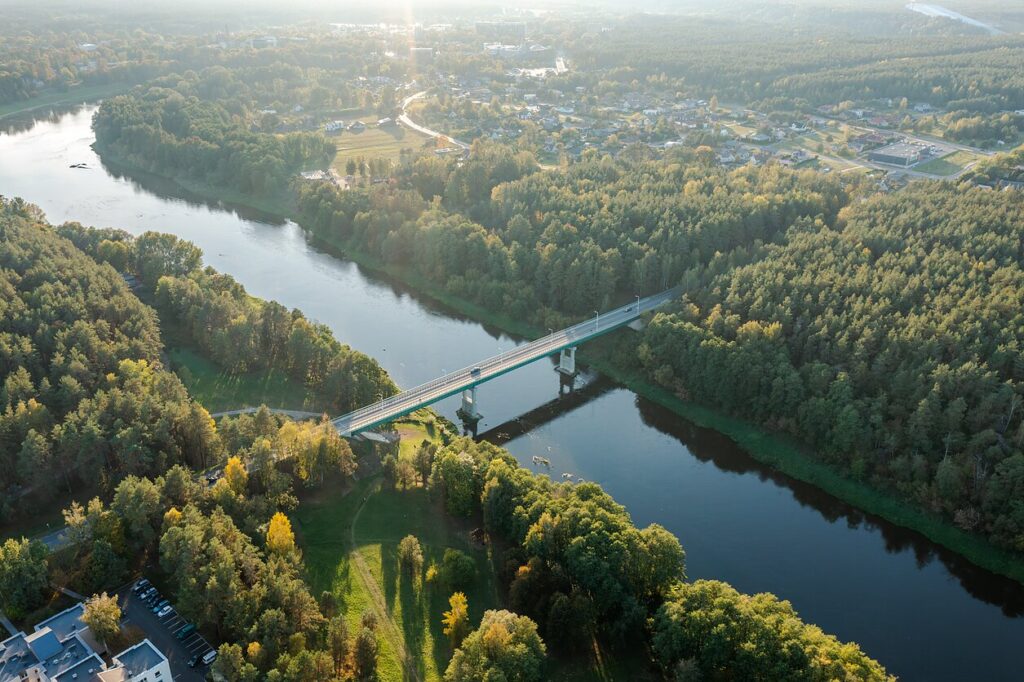
Lithuanians – close to the elite
The camp was crowned by the World Ranking competition, which was also full of sporting intrigue. In the men’s group, Lithuanian representative Tautvydas Rimkus won 6th place, and in the women’s competition, Judita Traubaitė took 5th place, competing with the strongest European athletes.
Finnish athlete Syrjäläinen Topis won the men’s group, and second place went to young Estonian athlete Joonas Jürgen, who demonstrated excellent preparation for the season. In the women’s group, Danish athlete Annika Gautschi Simonsen won, and Sandra Grosberga, the representative of neighbouring Latvia, took second place.
According to V. Aleliūnas, the Lithuanian terrain itself can level the playing field.
“We can already see that Lithuanians, Latvians, Estonians compete on equal terms with the strongest athletes in the world in this type of terrain. These are our forests, we are used to them. This means that the competition in the championship will be even more interesting – both for participants and spectators,” he says.
Preparations for the championship are gaining momentum
The second camp is just one of the stages in preparation for the largest orienteering event ever held in Lithuania. At the end of August, the third and final, official camp will be held in Lithuania at the end of August. This camp will serve as a decisive test before the championship and is the last step during which countries will finally select athletes for their national teams.
This will also be the last opportunity for the Lithuanian national team to finalise its composition: eight men and eight women who will represent Lithuania at the European Championship will be determined. According to V. Aleliūnas, Lithuanian athletes at this championship will strive to enter the top six in the team relay competition and the top ten in the individual classification for both men and women.
The European Orienteering Championship will be held on September 22–27, 2026 in the Druskininkai area and the Lazdijai district. In total, over 300 athletes from more than 35 countries of the Old Continent are expected. The organisers invite you to watch the competition and support our athletes both live and via event broadcasts.
The European Orienteering Championships are partially financed by state funds, administered by the Lithuanian National Sports Agency.
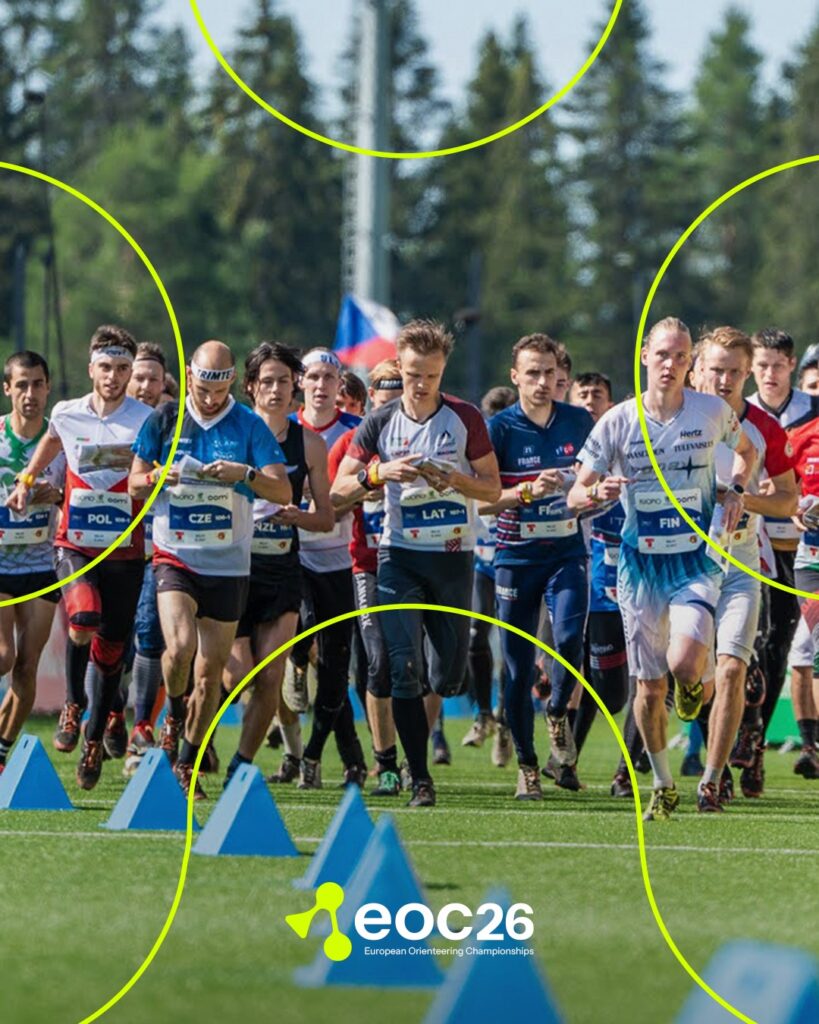
The 2nd official EOC 2026 training camp starts this tuesday, marking an important step on the road to the European Orienteering Championships 2026 in Lithuania. Interest in the camp has been strong, with more than 120 athletes from 16 countries already registered to take part. We invite all participants and visitors to explore the detailed information about the camp, including the programme, training opportunities, maps, accommodation, and other practical details.
With the European Orienteering Championship fast approaching, the official preparation starts.
7th – 12th April, Lithuania will host the second official EOC training camp for national teams and top-level athletes. Training and competitions will take place in the region of Druskininkai, Prienai and Alytus – places that will also be important for the upcoming championship.
Six technical training sessions during the week, made for targeted preparation for the competition, and on the weekend, athletes will have two World Ranking (WRE) competitions, providing an opportunity to test their form in real competition conditions.
This camp is part of a longer path to EOC26, where every training session, every start and every decision is important. Lithuania will become a special preparation area for the European elite in the spring to gain the momentum for the upcoming main event.
・Official information: https://bit.ly/eoc26-training-camp
・Registration: https://bit.ly/eoc26-registration
Important news for all orienteering enthusiasts!
Whether you want to cheer for your national team or experience the terrains of the European Orienteering Championships, this is your chance!
From September 25–27, 2026, alongside the European Orienteering Championships, the EOC Tour 2026 will take place — a three-day open competition for everyone who loves orienteering.
All details: https://eoc2026.lt/eoc-tour/competition/
Registration is now open: https://dbsportas.lt/en/varz/2026004
Don’t miss the chance to run in the same forests as Europe’s best!
Bulletins 1 & 2 for the European Orienteering Championships 2026 in Druskininkai, Lithuania are now published!
Inside you’ll find all the key information you need to start preparing for an unforgettable week September 22–27, 2026 – when Europe’s best will gather in Lithuania for the grand final of the World Cup.
Check them out now on our official website – www.eoc2026.lt
We can’t wait to welcome athletes, coaches, teams, and fans to Druskininkai – let the journey begin!

Lithuania will welcome the elite of orienteering. The European championship will be held in Druskininkai and Lazdijai on September 22-27, becoming the largest orienteering event in the country’s history. Over 300 athletes from more than 35 European countries will compete in the forests of Dzūkija.
“This is the largest orienteering event in the history of independent Lithuania that we will organise. Exactly 20 years ago, the World Youth Championship was held in Druskininkai, in the same forests, and now we are returning to the same area. Organising this championship is part of the Lithuanian Orienteering Federation’s strategy because we want to organise international competitions every two years to qualify for the World Championship. Along with the European Championship, the final stage of the World Cup will also be held in Druskininkai, which has never been held in Lithuania before,” said Vilius Aleliūnas, Executive Director and Competition Director of the Lithuanian Orienteering Federation.
The European Championships are organised every year: in even years, there are competitions in qualification, relays, long and medium courses in forests, while in odd years, there is a sprint held within city limits. Lithuanians submitted their application to organise the European Championship 4 years ago, and in the decisive duel for the title of host, our team competed with the Portuguese.
“The application process in orienteering begins 4 years before the championship. Then, for less than a year, those applications are evaluated, after which two candidates are selected, and negotiations begin with them. In our case, we competed with the Portuguese, but since we have the ambition to organise the World Championship, this time the chance to organise the European Championship was given to us,” said V. Aleliūnas happily.
Throughout history, Lithuanian representatives have broken onto the podium at the European Orienteering Championship twice: in 2004, Dainora Alšauskaitė won silver in the women’s middle distance, and in 2002, the women’s relay team, consisting of Giedrė Voverienė, Vilma Rudzenskaitė and Ieva Sargaudytė, won bronze.
At the 2026 championship in Druskininkai, Lithuanians, as hosts, will have a maximum quota of 16 athletes (8 men and 8 women), with the greatest hopes tied to the women’s team. It is expected that biathlete Judita Traubaitė, who successfully participated in the Milan-Cortina Winter Olympics, will also compete in the European Championship.
“Lithuania is currently experiencing a generational change in orienteering, but as hosts we will have the largest quota. In September 2025, we appointed a new national team coach, created a new “Team Lithuania” program and selected 19 athletes who are preparing specifically for this European Championship. Our greatest hope in the championship is the women’s team, we hope that Judita Traubaitė will also be able to participate. We also have two experienced athletes, Aušrinė Kutkaitė and Gabija Ražaitytė, so they are capable of competing for the top 10 in the women’s relay. We hope that they will also have the home court advantage, because in orienteering it is very important to compete in a familiar area, in familiar forests,” said V. Aleliūnas.
With just over half a year left until the historic orienteering event in Druskininkai, the championship organisers have already completed a significant part of the preparatory work. By the way, the competition will be broadcast not only in Lithuania, but also in Sweden, Norway, Finland, Italy, Austria and Estonia.
“Orienteering takes place in a real forest, so it was very important to choose a location that meets international standards. By September 2025, we should have drawn a map and planned the routes, so this stage has already passed. In November, we had a visit from a television team that walked through the forests, looking at camera placements. We also are faced with a internet connection challenge: although it is quite accessible in Lithuania, we have some issues in the forests. Currently, volunteers are being recruited, and the team of judges has already been assembled,” V. Aleliūnas summarised.
The European Orienteering Championships are partially financed by state funds, administered by the Lithuanian National Sports Agency.